- Why does arthroscopic surgery sometimes fail?
- Why do some keyhole surgeries not hold and how to prevent it?
- Sometimes an arthroscopic surgery could fail. Here are some reasons.
A failed repair does not always mean a bad surgery
Arthroscopy lets surgeons treat joint injuries through small incisions without cutting open large portions of tissue and bone. When undergoing an arthroscopy surgery, recovery is faster and outcomes are excellent.
But, a few patients return with persistent pain, instability or a re-tear. The question we are likely to ask when the patient returns is: was the first surgery done incorrectly, or is something else going on? The most common misconception is the belief that a failed repair means a poorly done surgery. When a re-tear occurs, it is caused mostly due to a combination of biology, technique, rehabilitation and timing.
Why surgical precision still matters
One of the reasons for re-tears to occur is the technique that was used. In an ACL reconstruction how the graft is placed is of utmost importance. Even a slight deviation from the correct anatomical position can alter knee mechanics, increase stress on the graft and lead to stiffness or a re-tear over time. At Ortho-One, the graft is placed as close as possible to the original ligament.
The evidence shows the same. In a study of 460 ACL revision cases by the MARS Study Group, surgeons cited a technical cause of failure in 60% of cases. A femoral tunnel in the wrong position was the most common, found in 47.6% of cases, and it was the only cause in about a quarter of them.
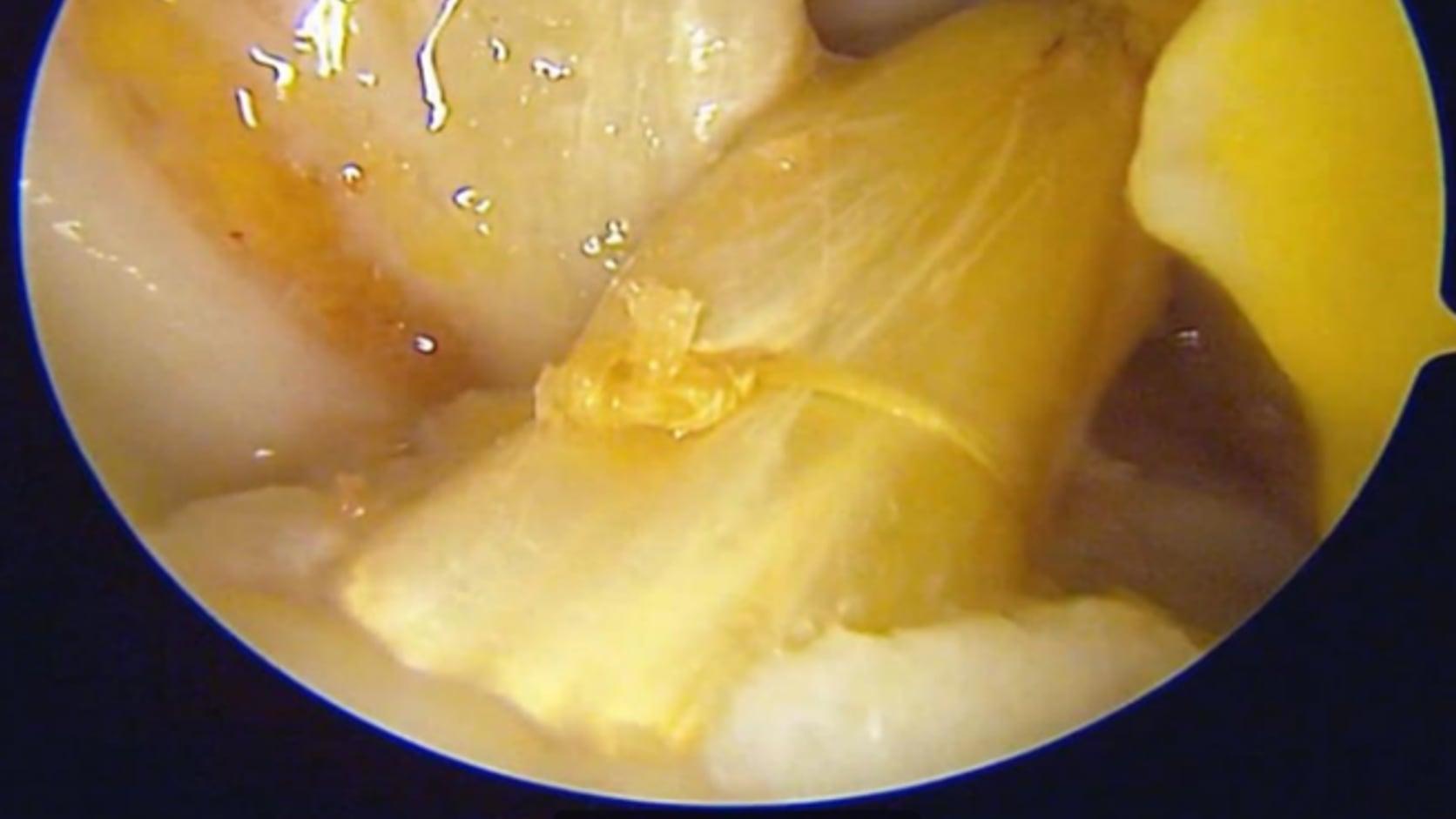
We treated a patient who came to us six months after ACL reconstruction elsewhere with a 20° fixed flexion deformity and knee flexion limited to 70°. The cause was severe internal scarring from non-anatomical graft placement. An arthroscopic release followed by structured rehabilitation, restored movement. When the graft is placed correctly initially,a revision surgery can be avoided.
What are some other reasons a repair can fail?
- Biology. All tissue heals differently. Some areas of a joint have poor blood supply, and chronically injured areas may not have enough healthy tissue to support a repair. Even a technically perfect repair can fail if the patient's biology does not support healing.
- Fixation. The repair must be stable enough to withstand the load placed on it as the joint begins to heal. If the fixation is incomplete or wrong for the tissue or tear pattern, the joint becomes vulnerable.
- Rehabilitation. The right amount of physiotherapy should be prescribed. Little to no physiotherapy can lead to stiffness and poor function. Aggressive rehabilitation introduced early can overstress healing structures and cause a re-tear or implant failure. Rehabilitation must be carefully timed, graded and supervised.
- Returning too soon. All tissue heals on a biological timeline but returning to sport too quickly can add stress to the joint and cause a re-tear. A recreational athlete we treated for ligament reconstruction went back to sport before completing rehabilitation. The result was graft failure and recurrent instability that needed revision surgery. ACL reconstruction typically requires 9 to 12 months before a return to competitive sport, and the return should be based on objective criteria not time alone.
The timing of rest is as important as the technique that is used during surgery. In the Delaware-Oslo ACL cohort study, published in the British Journal of Sports Medicine in 2016, the reinjury rate fell by 51% for each month that return to sport was delayed up to nine months after surgery. Patients who returned to jumping, cutting and pivoting sports were 4.32 times more likely to injure the knee.
How do I know if my surgery has failed?
Here are some signs to look out for:
- Pain that has returned or never fully went away after surgery
- Joint instability and a feeling of giving way
- Stiffness that limits range of motion
- Inability to return to activity you could perform before the injury
In many cases a revision arthroscopic surgery is possible. It is more technically demanding than the first, because the anatomy is altered and there may be scar tissue or compromised tissue quality. A thorough evaluation comes first.
The goal is to get it right the first time
At Ortho-One, a detailed assessment is done before every arthroscopic procedure.
- Detailed clinical examination. We evaluate tear pattern, tissue quality and patient demands before deciding on the surgery.
- Not every tear should be repaired. There’s a failure risk associated with forcing a repair on the tissue.
- Anatomical reconstruction and stable fixation. Correct graft placement and strong fixation are non-negotiable.
- Structured, phase-wise rehabilitation from day one. The rehabilitation plan is in place before the patient leaves the operating room. Physiotherapy helps to protect the joints while gradually helping the healing to progress.
Key takeaways
- A failed repair rarely has a single cause.
- Biology, technique, fixation, rehabilitation and timing all play a part.
- Rehabilitation matters as much as the procedure itself.
- Returning to sport too early is one of the most common causes of re-tear.
- In 460 ACL revisions, a technical cause of a misplaced femoral tunnel was cited in 60%.
- Each month of delay in returning to sport, up to nine months, cut the reinjury rate by 51%.
Frequently asked questions
How do I know if my arthroscopic surgery has failed?
Pay attention to pain that has returned or never fully went away, instability or a feeling of the joint giving way, stiffness that limits range of motion, or being unable to return to activity you could do before the injury. The first symptom is infection that could look like swelling and lymphangitis. In such cases loading with antibiotics. It needs to be controlled arthroscopically and the infection needs to be cleared out.
Can I have revision arthroscopic surgery if my first repair fails?
Yes, in many cases. Revision arthroscopy is more technically demanding than primary surgery, because the anatomy is altered and there may be scar tissue or compromised tissue quality. A thorough evaluation comes first.
How long should I wait after arthroscopic surgery before returning to sport?
It depends on the procedure and your rehabilitation progress. ACL reconstruction typically requires 9 to 12 months before a return to competitive sport. Your physiotherapist and surgeon at Ortho-One will clear you based on strength, symmetry and movement quality. A hamstring-to-quadriceps (H:Q) strength ratio test can also help decide if you are strong enough to return.
Had arthroscopic surgery but experiencing persistent pain?
If you are dealing with persistent pain, a suspected re-tear or a stiff joint after surgery, the orthopaedic team at Ortho-One Orthopaedic Speciality Centre, Coimbatore can evaluate your situation and give you clear answers about what has happened and what comes next.
Sources
- Morgan JA, Dahm D, Levy B, Stuart MJ; MARS Study Group. Femoral tunnel malposition in ACL revision reconstruction. Journal of Knee Surgery. 2012;25(5):361-368. https://doi.org/10.1055/s-0031-1299662
- Grindem H, Snyder-Mackler L, Moksnes H, Engebretsen L, Risberg MA. Simple decision rules can reduce reinjury risk by 84% after ACL reconstruction: the Delaware-Oslo ACL cohort study. British Journal of Sports Medicine. 2016;50(13):804-808. https://bjsm.bmj.com/content/50/13/804