What does your meniscus do and why is it worth saving?
It helps to understand what the meniscus does and how it can be saved, if you are worried that a meniscus tear will force you to have a lifetime of restrictions.
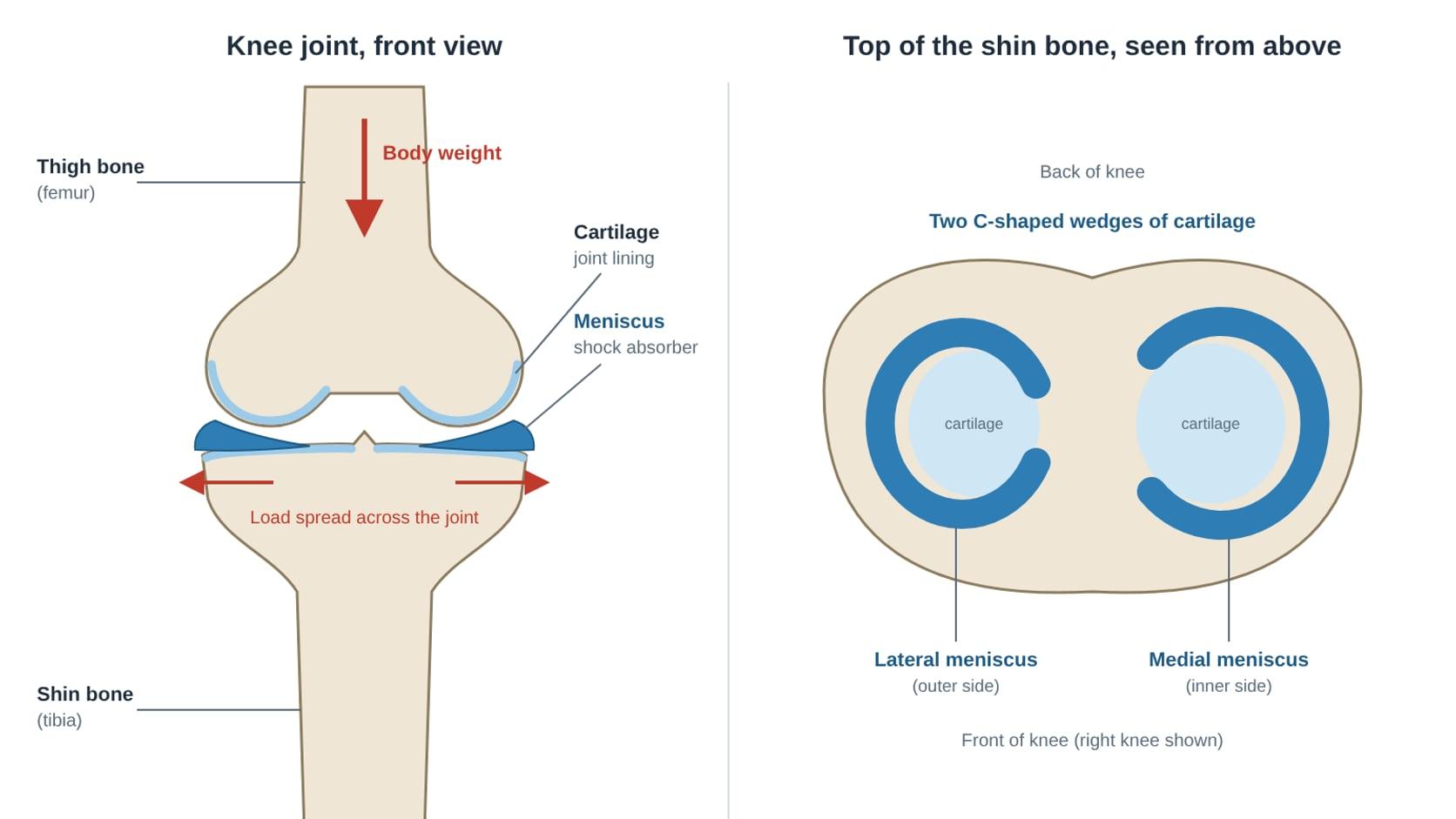
The meniscus is a C-shaped wedge of cartilage that sits between the thigh bone and the shin bone. It is the knee's natural shock absorber. It cushions impact, spreads load evenly across the joint and stabilises the knee during rotation.
The first answer should not be to remove the meniscus
When either one of the meniscus tears, the delicate balance of the thigh bone and the torso is disrupted. The load concentrates on the cartilage speeding up wear and tear, causing degeneration and the onset of arthritis.
A systematic review in Arthroscopy (2011) compared meniscus repair with partial removal of the meniscus. Repaired knees needed a second operation (20.7% versus 3.9% over the long term), but those patients had better knee function scores and less arthritic change on X-ray years later.
For this reason, specialists at Ortho-One repair and preserve the meniscus wherever possible instead of removing it.
What are the two ways to protect the meniscus?
Meniscus repair - The torn edges of the damaged meniscus are stitched and stabilised through arthroscopic techniques so the tissue can heal and protect the joint. When the meniscus is saved, the knee is more stable and distributes the load evenly on the joints which is crucial for long-term joint health.Image can be added here.
High Tibial Osteotomy (HTO) - A knee-preserving surgery that is done when knee pain is mainly due to misalignment. In middle-aged patients the leg can gradually shift into a bow-legged (varus) position, which forces the body's weight onto the inner (medial) side of the knee.
- The surgeon makes a controlled cut in the upper part of the shin bone (tibia) and gently opens it to change the angle of the leg.
- The shin bone is then fixed in its new position with a plate and screws.
Realigning the leg moves the weight from the damaged inner side to the healthier outer side of the knee.
A review of 23 studies in Scientific Reports (2017) found that ten years after surgery, 85 to 92% of osteotomies were still holding up, depending on the technique used.
Is HTO right for me?
HTO is recommended for active, non-obese, middle-aged patients who have arthritis in the medial compartment of the knee along with varus alignment.
The goal is to stop the wear before it is too late
Orthopaedic specialists can add decades of life to your natural knee joint just by correcting the way weight is distributed through the knees.
Key takeaways
- The meniscus is the knee's shock absorber. A tear on the meniscus can shift the load onto the cartilage.
- Ortho-One repairs and preserves the meniscus wherever possible instead of removing it.
- HTO realigns a bow-legged knee so weight moves to the healthier outer side.
- HTO suits active, non-obese, middle-aged patients with medial compartment arthritis and varus alignment.
- 85 to 92% of osteotomies are still holding up, ten years after HTO.
Frequently asked questions
What does the meniscus do?
The meniscus is a C-shaped wedge of cartilage between the thigh bone and the shin bone. It cushions impact, spreads load evenly across the joint and stabilises the knee during rotation.
Can a torn meniscus be repaired?
Often, is they are repaired early without delay. At Ortho-One, the torn edges are stitched and stabilised through arthroscopic techniques wherever possible, instead of removing the meniscus.
What is HTO?
High Tibial Osteotomy is a knee-preserving surgery to correct the alignment of the knee. It realigns the leg so that weight moves from the damaged inner side of the knee to the healthier outer side.
What happens during HTO?
The surgeon makes a controlled cut in the upper part of the shin bone and gently opens it to change the angle of the leg. The bone is then fixed in its new position with a plate and screws.
Who is HTO suitable for?
HTO is suitable for active, non-obese, middle-aged patients who have arthritis in the medial compartment of the knee along with varus (bow-legged) alignment.
Before you live with a torn meniscus
Call us today to have your MRI reviewed.
Sources
- Paxton ES, Stock MV, Brophy RH. Meniscal repair versus partial meniscectomy: a systematic review comparing reoperation rates and clinical outcomes. Arthroscopy. 2011;27(9):1275-1288. https://pubmed.ncbi.nlm.nih.gov/21820843/
- Kim JH, Kim HJ, Lee DH. Survival of opening versus closing wedge high tibial osteotomy: a meta-analysis. Scientific Reports. 2017;7:7296. https://www.ncbi.nlm.nih.gov/pmc/articles/PMC5544741/