Cartilage damage is not the end of your sport
If your MRI report says "cartilage damage" it does not have to end your time in sport. You don't have to live with a clicking or locking knee. The joint’s smooth surface can be restored through biological repair that will get you back to the gym or the court.
A review of 11 studies covering 931 athletes found full-thickness cartilage defects in the knees of 36% of them (Flanigan et al., Medicine and Science in Sports and Exercise, 2010).
Why there is no single fix for cartilage damage
Knee preservation includes a set of advanced treatments designed to protect and preserve your natural joint for as long as possible.
At Ortho-One, we first work out if the damage is in the cartilage, meniscus, ligaments or alignment. We then choose the least invasive option that can give you long-term relief. Four targeted treatments are offered. The two covered in this blog are meant for a localised area of cartilage damage and not meant for advanced or widespread arthritis.
What are the two ways to repair a localised area of damaged cartilage?
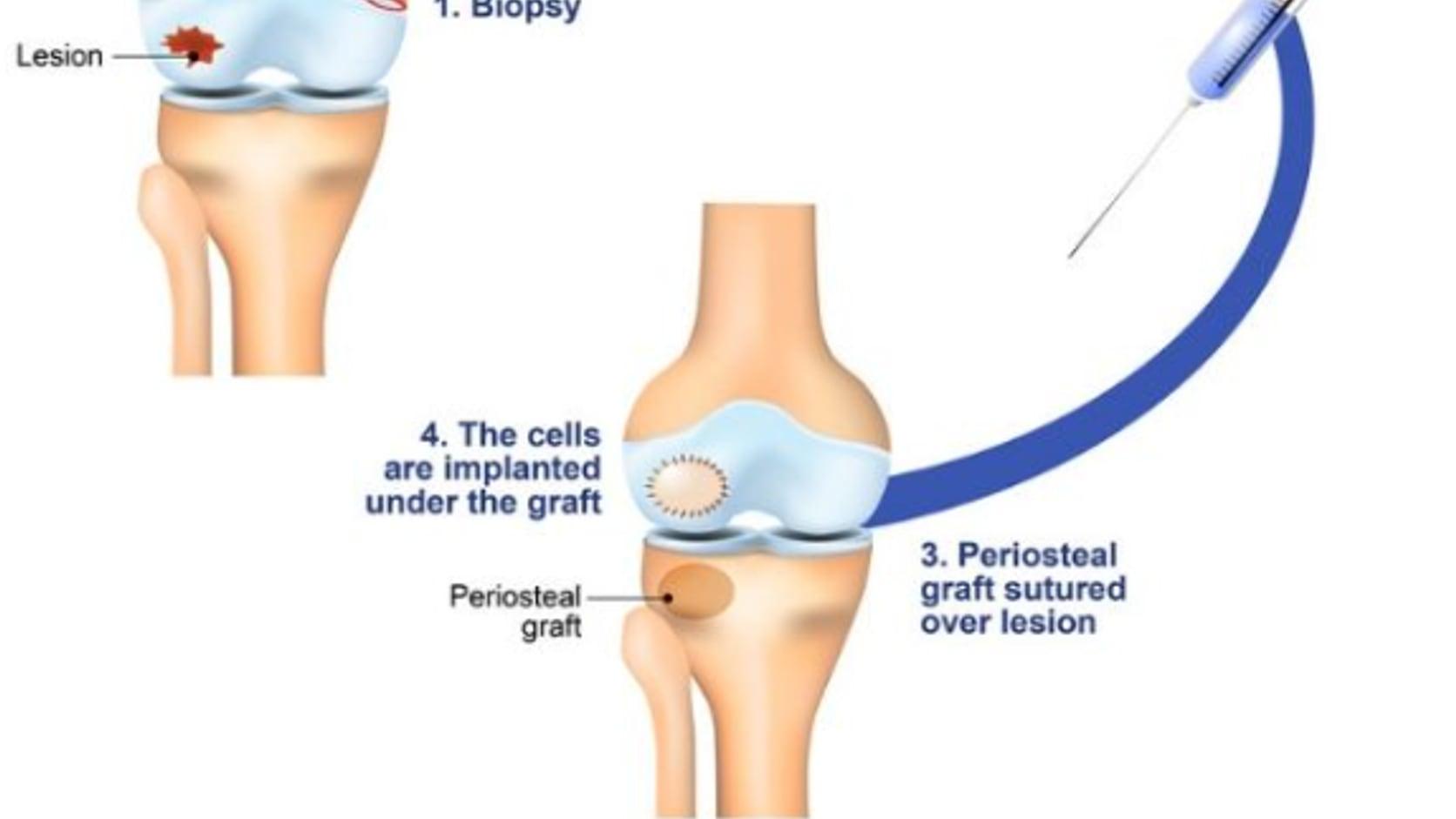
Autologous Chondrocyte Implantation (ACI) - An advanced cartilage-repair procedure that uses the athlete's own cells to fix a damaged area inside the knee.The steps involved in this procedure are:
Step 1: A small sample of healthy cartilage is taken from a non-weight-bearing part of the knee through keyhole surgery.
Step 2: The cells are grown in a specialised lab over a few weeks.
Step 3: The cells are re-implanted into the damaged area, where they form new, smooth cartilage over time.
ACI is usually recommended for younger, active patients with localised cartilage damage.
In a meta-analysis of 2,549 athletes, 82% returned to sport after ACI, at an average of about 12 months (Krych et al., Knee Surgery, Sports Traumatology, Arthroscopy, 2017). Other research studies show that the repair also lasts. In a study of 210 patients followed for at least 10 years, 71% of grafts had survived at 10 years and 75% of patients had improved function. About one in four grafts failed over that period (Minas et al., Clinical Orthopaedics and Related Research, 2014).
Osteochondral autografting (OATS) - A knee-preserving procedure for a small, well-defined area of cartilage damage. The surgeon takes small cylindrical plugs of healthy bone and cartilage from a non-weight-bearing part of the patient's own knee and transfers them into the damaged area.
OATS is recommended for active athletes with a clear cartilage injury. It aims to reduce pain, improve smooth movement and allow an early return to sport or demanding daily activity.
In a multicentre study of 354 athletes followed for an average of 9.6 years, results were good to excellent in 91% of those treated on the thigh-bone side of the knee, with slight deterioration over time (17-year multicentre mosaicplasty study, 2010).
Will my body accept the repair?
ACI and OATS procedures use the patient’s own tissue. Because OATS uses the patient's own bone and cartilage, there is no risk of rejection, and the transplanted cartilage can integrate well with the surrounding knee surface.
The goal is to have a structured plan and not an isolated procedure
Ortho-One Orthopaedic Speciality Centre, Coimbatore specializes in arthroscopic cartilage procedures and Osteochondral autografting that are performed regularly as part of a structured knee preservation programme.
Key takeaways
- If your MRI shows cartilage damage, it does not have to end your athletic life.
- ACI grows your own cartilage cells in a lab and re-implants them.
- OATS moves plugs of your own healthy bone and cartilage into the damaged area.
- ACI and OATS are for localised damage and not for advanced or widespread arthritis.
- In a meta-analysis of 2,549 athletes, 93% returned to sport after OATS and 82% after ACI.
Frequently asked questions
What is ACI?
Autologous Chondrocyte Implantation uses your own cartilage cells. A small sample is taken from a non-weight-bearing part of the knee through keyhole surgery, grown in a lab over a few weeks, and re-implanted into the damaged area.
What is OATS?
Osteochondral autografting moves small plugs of healthy bone and cartilage from a non-weight-bearing part of your own knee into a small, well-defined damaged area.
Who are these procedures suitable for?
ACI is usually recommended for younger, active patients and OATS is recommended for active athletes with a clear cartilage injury.These procedures are performed on individuals with localised cartilage loss in the athletic population.
Will my body reject the repair?
Both procedures use your own tissue. Because OATS uses your own bone and cartilage, there is no risk of rejection.
Can I return to sport after cartilage repair?
Yes you can after adequate rehabilitation and return-to-play assessment by the physiotherapist. In a meta-analysis of 2,549 athletes, 93% returned to sport after OATS, at about 5 months, and 82% after ACI, at about 12 months (Krych et al., Knee Surgery, Sports Traumatology, Arthroscopy, 2017).
Before you decide your sporting days are over
Contact us if your MRI shows cartilage damage.
Sources
- Flanigan DC, Harris JD, Trinh TQ, Siston RA, Brophy RH. Prevalence of chondral defects in athletes' knees: a systematic review. Medicine and Science in Sports and Exercise, 2010. https://pubmed.ncbi.nlm.nih.gov/20216470/
- Krych AJ, Pareek A, King AH, Johnson NR, Stuart MJ, Williams RJ. Return to sport after the surgical management of articular cartilage lesions in the knee: a meta-analysis. Knee Surgery, Sports Traumatology, Arthroscopy, vol. 25. https://pubmed.ncbi.nlm.nih.gov/27539401/
- Minas T, Von Keudell A, Bryant T, Gomoll AH. The John Insall Award: a minimum 10-year outcome study of autologous chondrocyte implantation. Clinical Orthopaedics and Related Research, 2014. https://pubmed.ncbi.nlm.nih.gov/23979923/
- Autologous osteochondral mosaicplasty in an athletic population: 17-year prospective multicentre study, 2010. https://pubmed.ncbi.nlm.nih.gov/20360608/.