Do you need a lateral extra-articular tenodesis (LET) when you are getting your ACL reconstructed?
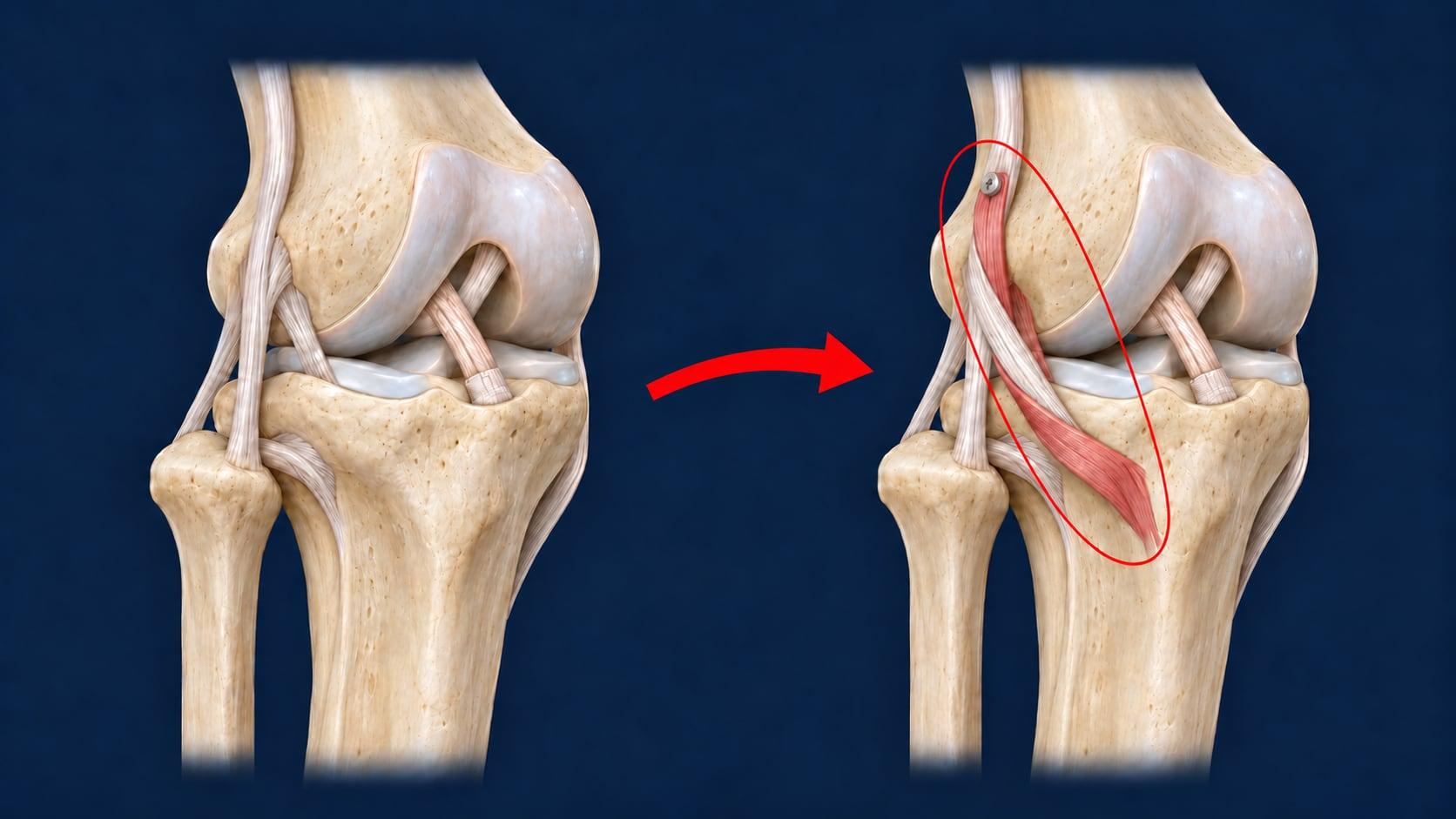
If you are having your ACL rebuilt you may be told to undergo an extra procedure on the outer side of the knee called a lateral extra-articular tenodesis (LET). A strip of tissue from the outer thigh is used to add rotational control to the knee in this procedure. It can sound like an obvious upgrade that offers more stability and lesser risk. But LET is an additional operation that is not needed for every knee.
Why LET is not needed on every knee?
LET is a well-studied procedure. In the STABILITY trial, patients aged 25 or under at high risk of re-injury all received a hamstring graft and half of them had LET. The graft rupture fell from 11% without LET to 4.5% with it (Getgood et al., STABILITY).
But these results came with conditions. The trial only included young patients with specific risk factors and it used hamstring grafts.
There is a short-term cost to undergoing a LET procedure. Patients who had LET reported more pain at 3 months and less improvement in knee scores at 3 and 6 months (Getgood et al., STABILITY).
When is LET needed and when is it not needed?
At Ortho One we add a LET procedure only when the knee needs it.
LET may be advised if:
- You are having revision surgery after a previous ACL reconstruction failed.
- You carry excess body weight, which puts more strain on the new graft.
- Your knee bends backwards (recurvatum and generalized laxity).
LET is usually not needed if:
- This is your first ACL reconstruction and none of the above apply.
Your surgeon will decide after examining your knee, checking imaging results and the sport you play.
Won't extra stability protect my graft anyway?
It is a fair question for athletes. For young patients at high risk with a hamstring graft it can protect the graft and add extra stability. For others the extra procedure can bring more early pain and a longer first few months of recovery.
For elite players our specialists weigh the demands of the sport.
The honest answer is that LET is for specific knees and not an upgrade for every knee.
The goal is restoring knee function
Our approach at Ortho-One is to give you a stable knee with the least intervention which means choosing the right graft and adding LET only based on the knee's risk profile.
Before you decide on ACL surgery
If you have been told your knee needs an LET procedure, book a knee consultation with our specialists so our knee surgeons can review your case.
FAQs
What is LET?
Lateral extra-articular tenodesis is an extra procedure that uses a strip of tissue from the outer thigh to add rotational control of the knee.
Does everyone having ACL surgery need LET?
No. It is used selectively, depending on your knee and your risk of surgery.
Does LET reduce the risk of the graft tearing again?
In young, high-risk patients with hamstring grafts, a large trial found it reduced the graft tearing again. Its added benefit with other grafts is still being studied.
Are there downsides to a LET procedure?
Patients who had LET reported more pain in the first 3 months but significantly improved by 12 months.
Sources
- Getgood et al., STABILITY trial
- STABILITY 2 trial protocol