An MRI scan alone is insufficient to finalise a surgery
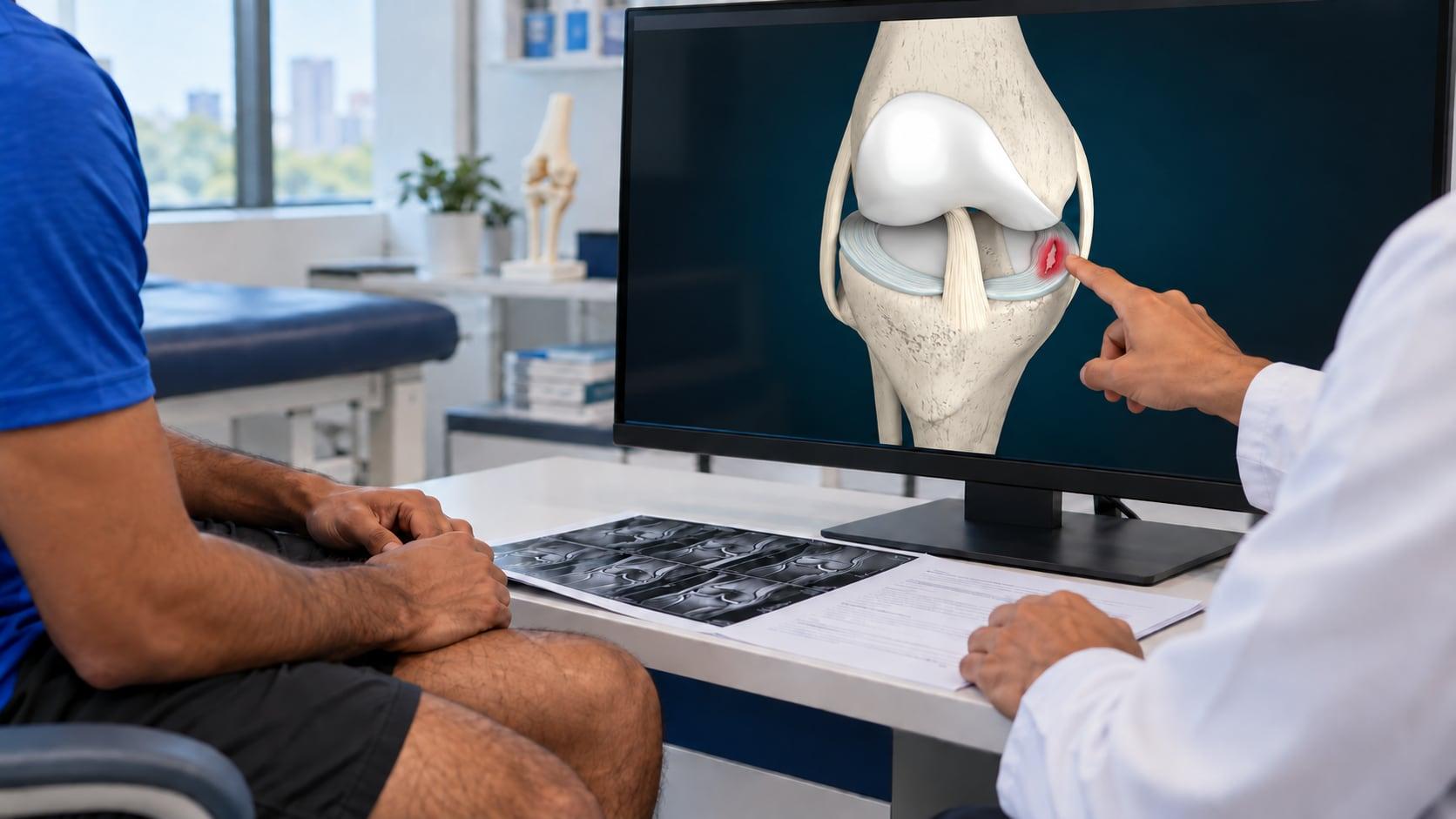
Many patients arrive at the centre after a knee injury with an MRI report that says "ACL tear" and expect to be rushed into surgery straight away. Our surgeons regularly see knee MRIs taken with too few image slices, or slices too thick to show the fine detail they need. On such a scan, a small meniscus tear or cartilage injury can be missed. These matter because what else is damaged inside the knee changes what the surgeon needs to do.
The method of taking the MRI matters more than the machine the scan was taken on.
The MRI is an excellent tool for knee injuries and in the right hands it is highly accurate. Research shows that even lower-strength machines can diagnose ACL tears as well as high-strength ones. In one study, accuracy was 90% at 0.5 T and 91% at 1.5 T (Radiology, 1995).
What changes the result is how the scan is done and who reads it:
- Slice thickness. European radiology guidance says 4 mm slices are acceptable for the knee, but 3 mm or thinner is preferred and available on most modern scanners (ESSR recommendations, 2024). Thicker slices can blur small meniscus tears out of view.
- Angle and planes. Angling the images along the ACL and adding views in more than one plane helps show the whole ligament (Orthopedic Research and Reviews).
- The reader. Studies note that the radiologist's experience affects accuracy especially for subtle tears (Low-field MRI study, PMC).
What can you do if you suspect your ACL is torn?
- See a knee specialist before the scan. A clinical examination by a specialist can tell him what to look for, and they can advise where to get the MRI done.
- Choose where you scan with care. Ask the centre whether it uses a dedicated knee protocol with thin slices (3 mm or less) and views in more than one plane and whether a musculoskeletal radiologist reports it.
- Bring the images and the report. Your surgeon needs to look at the scan and the report. Ask the centre for the full image files.
- Do not wait too long to decide. In a New Zealand registry of more than 15,000 ACL reconstructions, medial meniscus tears were found in 40% of knees operated 6 to 12 months after injury, rising to 53% after 12 months (NZ ACL Registry, 2025).
There are other options apart from surgery. In a randomised trial of young active adults, structured rehab with the option of later reconstruction gave results similar to early surgery at two years (Frobell et al., NEJM, 2010). The right choice depends on your knee, your sport and your goals.
What if you already have an MRI report of your ACL injury?
Bring the MRI scan along with the report. Ortho-One specialists will review the scan alongside a physical examination of your knee. If the scan is of good quality it will be used to decide next steps. If it does not show what the surgeon needs, a repeat scan with a proper knee protocol may be advised. It can feel like an extra cost but a second scan will cost far less than a planned surgery.
The goal is to protect the knee and not just fix the ligament
The ACL is what keeps the knee stable. Without it, the knee can keep giving way, and each episode risks damage to the meniscus and cartilage. A study of 609 patients found that waiting more than 8 weeks raised the risk of a medial meniscus tear that could no longer be repaired (Cohort study, 2019). The meniscus is the knee's shock absorber. Saving it is one of the main reasons we treat ACL tears seriously, and one reason we want the clearest possible picture before surgery.
Before you decide on ACL surgery
If you have injured your knee, see our knee specialists before you take an MRI scan. We will let you know what diagnostics we require and then plan for your treatment.
FAQs
Can a surgeon plan ACL surgery from any MRI?
No, a surgeon won't be able to plan ACL surgery just from an MRI alone. If the slices are too thick or key views are missing, small meniscus or cartilage injuries can be missed.
Is a 3T MRI always better than a 1.5T one for an ACL tear?
Not necessarily. Studies show that both machines have similar accuracy across field strengths. The method of the scan and the radiologist's experience matters more.
How soon should I see a specialist after an ACL tear?
You need to see a specialist as soon as possible. If you delay it for more than 3 months, it could lead to more meniscus and cartilage damage.
Does every torn ACL need surgery?
No, many individuals do well with structured rehabilitation. Your specialist will advise based on your knee, sport, age and goals.
Sources
- Radiology, 1995: ACL tear accuracy at 0.5 T and 1.5 T
- ESSR, 2024: MRI of the knee practice recommendations
- Orthopedic Research and Reviews: MRI of ACL injury
- Low-field MRI vs arthroscopy study (PMC)
- New Zealand ACL Registry, 2025: timing and meniscal tears
- Cohort study, 2019: delayed ACL reconstruction and medial compartment
- Frobell et al., NEJM, 2010: KANON trial