If you have been scheduled for ACL surgery, ask your specialist what graft options are available to you.
A torn ACL cannot simply be stitched back together. It is reconstructed using a graft which could be a strip of tendon, usually taken from your own body. The graft you receive affects how quickly it heals into bone, how likely it is to tear again, and whether you will have knee pain later. For an athlete planning to return to sport these differences matter.
Why a hamstring graft may not be enough for athletes?
The hamstring graft is widely used for ACL reconstructions and works well for many patients. In the Scandinavian registries it made up 84% of reconstructions. It leaves a very small scar and causes less pain when kneeling.
For young, active athletes, though, the numbers leaned the other way. A study of nearly 46,000 ACL reconstructions across Norway, Sweden and Denmark found that patients who received a patellar tendon graft had a significantly lower risk of needing revision surgery than those given a hamstring graft (Gifstad et al., AJSM, 2014). At five years, failure rates were 2.8% for patellar tendon and 4.2% for hamstring (Journal of ISAKOS review).
The reason lies in how each graft heals. A patellar tendon graft carries a small plug of bone at each end, which heals to the bone tunnel much like a fracture. A hamstring graft is soft tissue only and takes longer to anchor (Annals of Joint, 2024).
What are your graft options?
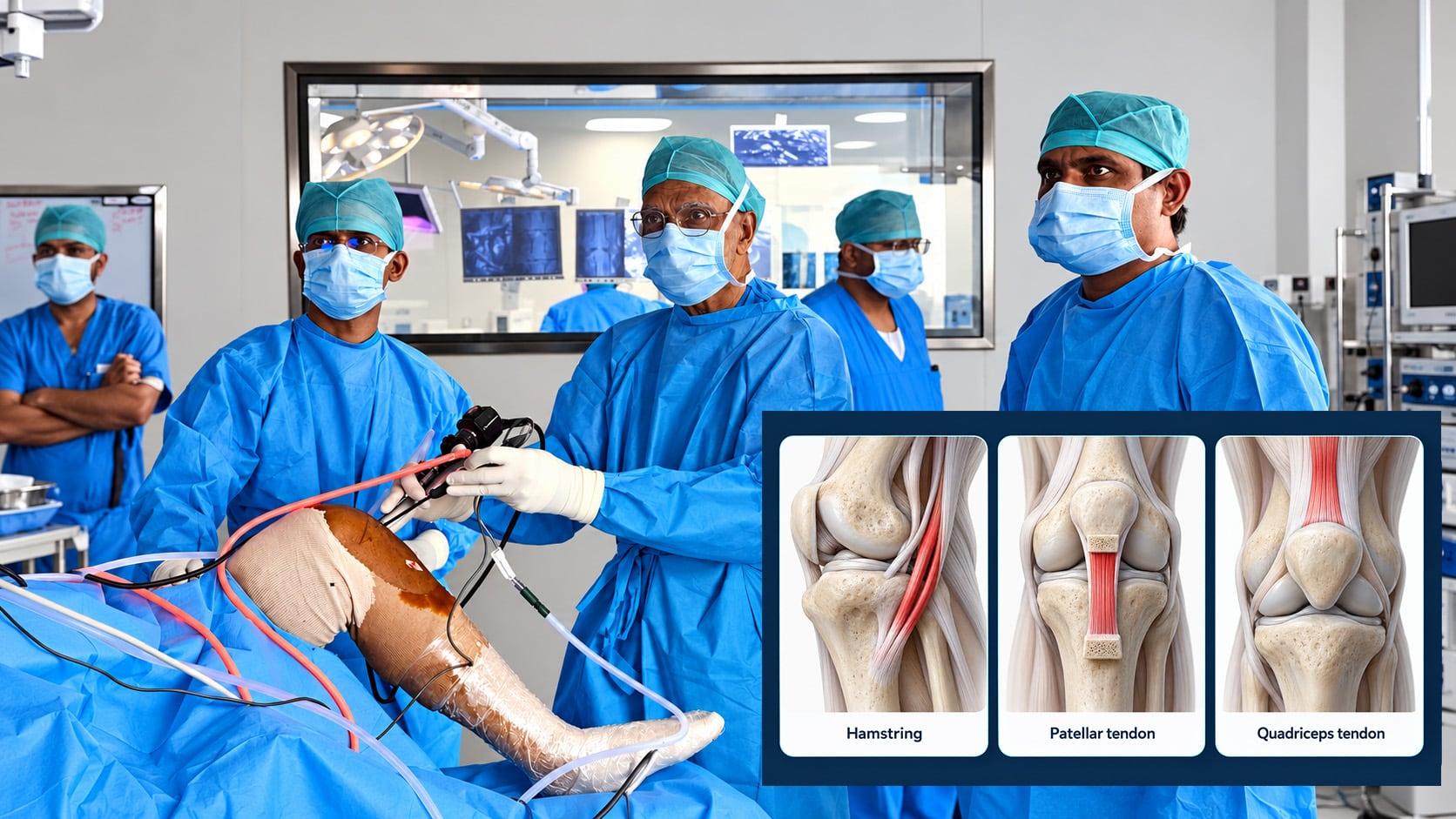
Patellar tendon (bone-patellar tendon-bone)
Heals bone-to-bone, with more reliable healing in the tunnel. It carries a lower revision risk, but more pain when kneeling.
Hamstring
Heals soft tissue to bone and is slower to anchor. It causes less kneeling pain and leaves a smaller scar, but carries a higher revision surgery risk.
Quadriceps tendon
Used with or without a bone block. A 2024 review found lower graft failure than hamstring and less donor-site pain than patellar tendon, with function similar to both. There are fewer randomised trials and results depend on surgeon experience.
The quadriceps tendon (QT) graft. A QT graft is a strip taken from the quadriceps tendon, just above the kneecap. A review of 21 studies covering 2,964 patients found that QT grafts had a lower risk of graft failure than hamstring grafts, and a lower risk of donor-site pain than patellar tendon grafts. The authors called QT a safe and effective alternative, while noting that its superiority has not yet been proven in randomised trials (Zhang et al., Journal of Orthopaedics and Traumatology, 2024).
In athletes specifically, a 2026 review of three studies (165 athletes) found QT and patellar tendon grafts comparable for return to sport, graft failure and knee function. The evidence base is still small (Salazar Mendoza et al., 2026).
The experience of the surgeon doing this procedure matters. In the Danish registry, QT grafts at first showed a higher revision rate than the other two: 4.9% at two years, against 2.3% for patellar tendon and 1.6% for hamstring (Danish registry study). A follow-up traced the excess to clinics that had done fewer than 100 QT procedures, where revision was 6.4% against 2.9% in high-volume clinics (Lind et al., KSSTA).
For athletes returning to cutting and pivoting sports, our surgeons generally prefer a quadriceps tendon or patellar tendon graft over a hamstring graft.
Do I need extra stabilisation?
Some patients are told they need an extra procedure called LET alongside the ACL reconstruction. At Ortho One, we do not add it routinely. We explain when it helps, and when it does not, in our blog on LET.
The goal is to get the right graft done once.
Our aim at Ortho-One is to reconstruct the ACL in a way that heals reliably and lasts, so you return to your sport and participate successfully. This requires matching the graft to your body, your sport and your goals and adding extra procedures only when your knee truly needs them.
Before you choose your ACL graft
If you are planning ACL reconstruction surgery, talk to our knee surgeons about which graft suits your sport and your knee.
FAQs
What is an ACL graft?
A piece of tendon, usually from your own body, is used to rebuild the torn ligament.
Which graft is best for athletes?
Registry data show a lower revision risk with patellar tendon grafts than hamstring grafts. Quadriceps tendon (QT) grafts are a newer option. Early studies in athletes show return to sport and graft failure similar to patellar tendon grafts, and reviews report less donor-site pain. Your knee specialist will choose the graft based on your sport and your knee.
Will a patellar tendon graft cause knee pain?
It can cause pain while kneeling.
Sources
- Gifstad et al., AJSM, 2014: Scandinavian registry, 45,998 reconstructions
- Journal of ISAKOS review: patellar tendon graft in high-risk patients
- Annals of Joint, 2024: healing and complications by graft type
- Minimally invasive BPTB harvest study (PMC)
- Swedish Knee Ligament Registry: quadriceps vs hamstring and patellar tendon
- Getgood et al., STABILITY trial
- STABILITY 2 trial protocol
- Zhang et al., 2024: QT vs patellar tendon and hamstring, 21 studies
- Salazar Mendoza et al., 2026: QT vs patellar tendon in athletes
- Danish registry: revision rates by graft type
- Lind et al., KSSTA: QT revision rates and surgical volume