Knee replacement is a life-changing surgery when joint damage is too advanced for preservation to give the patient reliable, long-term relief. In certain cases, considering a knee preserving procedure will not meaningfully improve function.
A knee replacement is suggested when:
• X‑rays and MRI show severe, widespread cartilage loss, large osteophytes and deformity.
• Pain is constant and interferes with sleep, walking, standing or basic self‑care, despite physiotherapy, medicines, and lifestyle changes.
• The knee has very restricted bending or straightening that makes walking difficult or unsafe.
• The joint feels unreliable and unsafe even during simple activities, increasing the risk of falls.
• The patient is faced with a reduction in meaningful activities like work, household chores, social/family commitments.
• All other options are exhausted.
An early diagnosis is the biggest advantage for knee preservation. You should see a knee specialist promptly if you notice:
• Pain that lasts more than 2-3 weeks
• Swelling, locking, or "catching" inside the knee
• A feeling of giving way or instability
• Difficulty with routine activities
• Visible deformity or progressive bow‑leg/knock‑knee
If you have any of these signs, book an appointment with our knee replacement specialist rather than rely on painkillers to identify if simple measures, physiotherapy, or knee preservation treatments are adequate or whether more advanced procedures are required.
Early imaging and a focused consultation can be the difference between preserving the knee and reaching the stage where replacement is the only realistic option.
At Ortho-One, knee preservation is treated as the first question and not as an afterthought. As a pioneering centre in arthroscopy, joint preservation and sports medicine, Ortho One's approach involves precise diagnosis, minimally invasive techniques and rehabilitation to protect the natural joint for as long as possible.
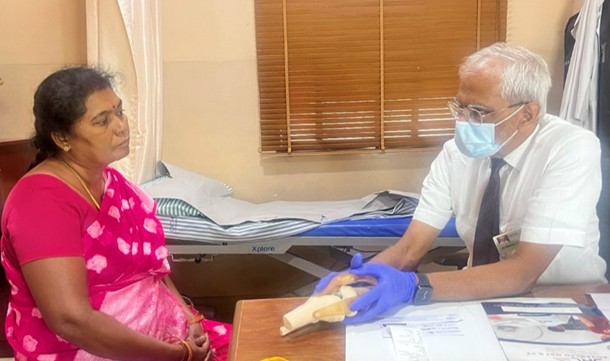
Dr. David V Rajan says that every knee is assessed on three pillars.
Stage of damage
a. Is the problem caused due to cartilage defect, meniscus tear or early arthritis?
b. Is the whole joint worn out.
Patient's goals
a. Is the patient a young athlete, a working adult, or a senior?
b. Is the patient unable to squat or sit on the floor?
Long‑term plan
a. Which treatment option today gives the best function over the next 10-15 years?
b. Will the treatment only provide relief for the next couple of months?
In practice, our specialists consider younger and middle‑aged patients for arthroscopic cartilage procedures like ACI, Meniscus repair, and HTO rather than knee replacement. At Ortho-One, there is a high‑volume of experience in arthroscopy and daily knee surgeries by sub‑specialised surgeons that allows the team to choose knee preserving options confidently where they are truly appropriate, while still recommending replacement when the joint is clearly beyond preservation.
Step 1: Observe your pain clearly? How long has it been there? Where exactly does it hurt? What triggers the knee pain?
Step 2: Protect your knee by stopping movements that trigger pain. If the pain is acute follow the RICE method to reduce pain: Rest, Ice, gentle Compression, Elevation.
Step 3: Check for red flags like swelling, a feeling that the knee might give way or persistent pain.
Step 4: Plan a proper assessment at Ortho-One, Coimbatore.
If you want the checklist as a simple one-page PDF, download it here DOWNLOAD
Download the "Knee Pain Checklist" and bring it with you to your consultation.
Step 1: Observe your pain clearly
• How long has it been there? (Less than a week / 2-3 weeks / months)
• Where exactly does it hurt? (Front, inner side, outer side, behind the knee)
• What triggers knee pain? (Stairs, squatting, walking, getting up from floor, running, gym)
Step 2: Give the knee short‑term protection
• Cut down or stop the movements that clearly worsen pain (e.g., deep squats, running, heavy lifting).
• Use the RICE principle for 3-5 days if pain is acute: Rest, Ice, gentle Compression, Elevation.
• Do not rely on strong painkillers without medical advice.
Step 3: Check for red‑flags
See a knee specialist urgently if you notice
• Sudden swelling, locking, or inability to straighten or bend the knee fully.
• A feeling that the knee is "giving way" or might slip.
• A sports injury with persistent pain.
• A worsening bow‑leg or knock‑knee condition.
Step 4: Plan a proper assessment
• Write down your symptoms, duration and past injuries.
• Book an appointment with a knee specialist.
Step 5: Ask your consultant the right questions
• Is my knee at a stage where preservation is possible?
• What are the non‑surgical and joint‑preserving options before requiring replacement?

When The First Surgery Isnt Enough: Revision Surgeries At Ortho One Orthopaedic Speciality Centre

Address
Operational Hours:
10:00 AM – 7:00 PM | Monday to Saturday
Facilities
Treatments
Quick Links



 Book an appointment
 Athletes Empowerment
 Orthopaedic Education