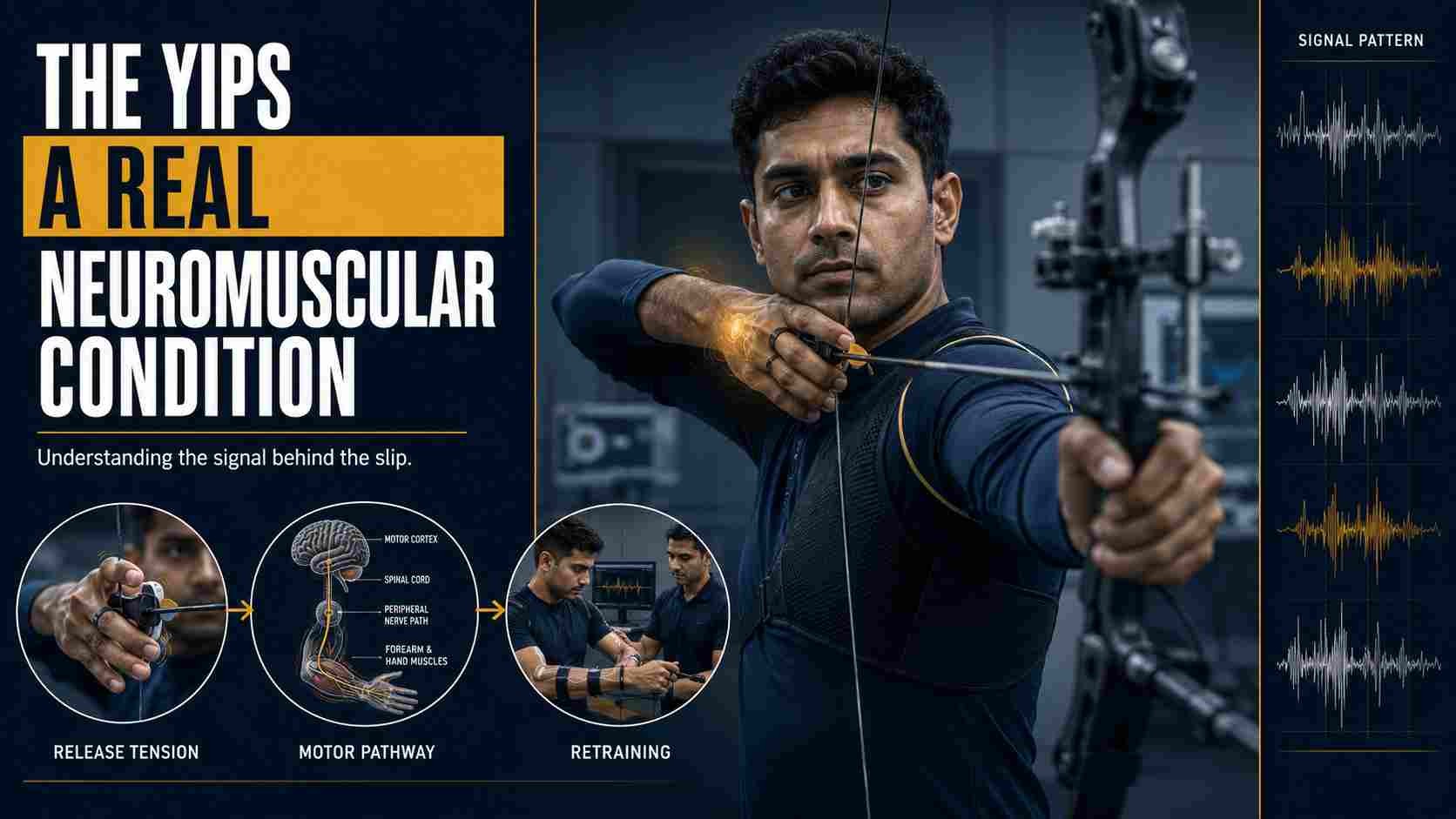
Imagine you are an athlete and are training for months, performing consistently during practice but your hand begins to suddenly jerk, freeze or move completely out of control during a competition. That experience is yips. It is more common and more treatable than most athletes realise.
At Ortho-One Orthopaedic Speciality Centre, Coimbatore, our sports medicine team regularly helps athletes who have been quietly suffering with this condition, unsure what to call it or where to turn. This guide explains what the yips are, why they happen, how they feel, and what effective sports medicine treatment for yips looks like.

The yips are involuntary disturbances of fine motor control that occur during well-learned, precise movements typically under pressure and especially during competition.
A 32-year-old professional shooter visited Ortho-One's Sports Medicine Department after months of unexplained performance problems. He complained of his finger moving abruptly exactly at the moment of firing that caused him to miss targets that he would normally hit with ease. He also experienced brief sensations of stiffness where his hand would momentarily freeze just before the shot. Despite intense and consistent practice he complained of a loss of control during important matches.
We concluded that his symptoms were identified as the yips, a condition involving involuntary muscle activity during precise movements. We put him through a structured sports medicine rehabilitation programme focused on relaxation, motor retraining, and a gradual return to competition. His control of movement improved and tremors reduced. He returned to shooting with better stability and precision.
The yips occur in sports that require precise and repetitive fine motor actions like golf, rifle and pistol shooting, archery, cricket, baseball, and darts. It is seen in any activity where milliseconds and millimetres matter and where performance pressure is high.
The yips usually occur only during a specific sports action and not during everyday activities like writing, lifting objects, or using tools. This task-specific nature of the condition is one of the most important clues in identifying the condition correctly.
Athletes get the Yips due to a combination of neurological factors and psychological stress.

The yips resemble a task-specific movement disorder known as focal dystonia. The brain areas responsible for fine motor control undergo subtle maladaptive changes after years of repetitive training. These changes cause the brain to send mixed signals to the muscles causing them to contract at the wrong time. This makes the muscle work abnormally causing smooth and coordinated movement difficult.
The brain fires precise coordinated signals for smooth automatic movements.
Athletes with dystonia show disrupted signals. Research using electromyography (EMG) has demonstrated irregular muscle firing patterns in athletes affected with the yips. The muscles that should relax at the moment of action contract and cause jerks, tremors, or freeze.
For some athletes that have the yips, performance anxiety could play a large role. They may experience increased heart rate, tensed muscles and begin to overthink their actions that were previously automatic.
The fear of failure, pressure to perform and memory of previous mistakes can make muscles tense and make smooth movement difficult. Anxiety can frequently act as a trigger in athletes who are already neurologically vulnerable.
When an athlete becomes hyper-aware of a movement they have performed thousands of times, something shifts. The action moves from the automatic, efficient part of the brain back into conscious deliberate control exactly where fine motor performance breaks down. The result is over-monitoring, over-controlling, and ultimately, loss of the fluid movement that makes precise sport possible.
Most athletes fall somewhere between the purely neurological and purely psychological extremes. Research shows that affected athletes often demonstrate both abnormal muscle activation and increased physiological arousal during competition. In some athletes the yips are mainly psychological, in others neurological. Many experience a combination of both and treatment effectiveness is reflected in results.

Athletes with the yips often describe the movement as not feeling right. They experience small twitches, sudden jerks or shaking just before pulling the trigger or releasing an arrow. Some feel frozen and unable to move. The symptoms can vary from subtle inconsistencies to dramatic, visible loss of control.
What makes the condition particularly distressing is that it appears in sharp contrast to how well an athlete can perform in training. A golfer who putts with ease on the golf range finds that the same shot becomes unpredictable under competition conditions.
The condition is specifically connected to sports action, competition and the pressure of performance. One of the most confusing aspects of the yips is its task-specific nature. The hand that jerks during a golf putt functions perfectly during other everyday tasks like writing or eating.
This feature of the condition is what makes the yips hard to understand for athletes, coaches, and even medical professionals who are unfamiliar with the condition. It can be mistaken for a technique problem, a general anxiety disorder or even a character issue.
Sports medicine for the yips focuses on retraining the brain and muscles to work smoothly together. The aim of treatment is to restore coordination between the brain and muscles and reduce excessive muscle tension.
Sensorimotor retraining is a treatment for the yips. It recalibrates the brain's internal map of movement to feel the movement and restores body awareness, hand control, and muscle timing.
Mirror exercises allow athletes to observe and feel correct movement patterns. Slow-motion drills reduce the speed at which errors occur and allow the nervous system to re-learn proper sequencing. Tactile training uses touch and feedback during movement to restore sensory signals that the brain can then use to guide fine motor control.
Neuromuscular retraining helps athletes to relax muscles that are tightened and activate the correct muscles during an activity. Biofeedback allows athletes to see in real time when their muscles are working too hard and consciously reduce unnecessary tension.

Biofeedback devices measure electrical activity in the muscles and display it as a visual or auditory signal. When an athlete sees when their muscles fire abnormally they can learn how to bring it under control. When done consistently, it helps athletes to build a new, calmer muscle to prevent the yips episodes during competition.
Poor shoulder control, incorrect posture, or chronically tight forearm muscles can all contribute to a loss of fine motor control in the hand. When proximal stability which is the foundation of shoulder, core, and trunk is compromised, distal precision suffers.
Gentle manual therapy, targeted stretching, and corrective exercises can improve movement efficiency throughout the chain and reduce the abnormal muscle activity that drives the yips. This whole-body approach is one reason that sports medicine treatment is more effective than simply addressing the affected hand in isolation.
It is both and that is precisely what makes it complex. The yips represent a psycho-neuromuscular condition that sits at the intersection of neurological function and psychological stress. In some athletes, the neurological component dominates; in others, anxiety is the primary driver. Most experience a combination. Effective treatment addresses both sides of the equation.
The yips typically require professional sports medicine intervention. Coaches can support athletes affected by the yips by reducing performance pressure, adjusting training demands, and avoiding language that increases self-consciousness.
However, sports medicine intervention is needed to retrain abnormal motor patterns, resolve underlying neurological or psychological factors through a structured rehabilitation programme.
Recovery depends greatly on how long the yips have been present, whether the cause is neurological, psychological or combined and how consistently the athlete engages in rehabilitation. Early diagnosis consistently improves the speed and completeness of recovery.
The yips affect recreational athletes and olympic-level competitors. Professional athletes face greater performance pressure but the neurological changes associated with task-specific dystonia can develop in any athlete who has spent significant time repeating precise movements. Long practice histories are often a contributing factor to the yips.
The yips are real and treatable. Our sport medicine specialists at Ortho One Orthopaedic Speciality Centre, Coimbatore use evidence-based rehabilitation that includes sensorimotor retraining, neuromuscular therapy, and biofeedback to help athletes regain smooth, confident movement and return to competitive sports.
Book a Sports Medicine Consultation at Ortho-One, Coimbatore.

Address
Operational Hours:
10:00 AM – 7:00 PM | Monday to Saturday
Facilities
Treatments
Quick Links



 Book an appointment
 Athletes Empowerment
 Orthopaedic Education