At Ortho One, we regularly see professional and recreational athletes who perform repetitive overhead movements like swimmers, tennis players, gym-goers who come to us with arm tightness that gradually works its way up into the shoulder, making even simple overhead tasks painful.
We've also treated patients who spent years living abroad managing everything themselves like washing the car, doing housework, lifting and reaching without a second thought only to develop nagging shoulder pain over time.
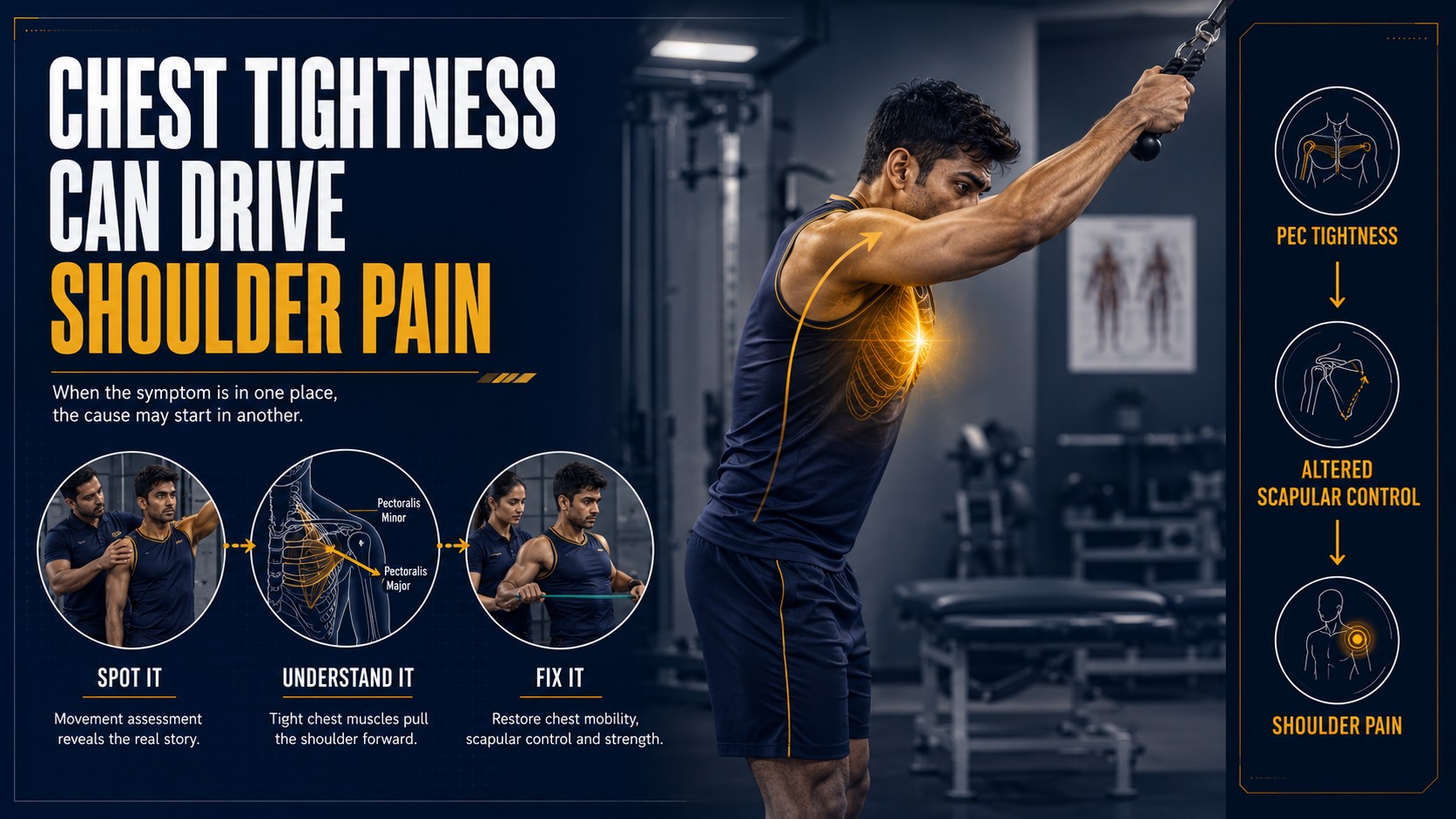
In all these cases, the pain showed up in the shoulder, but started with a chronically tight chest.

Athletes push their bodies hard to get in more reps or lift heavier loads or get faster times. A stronger chest is often seen as a marker of progress but it can set the stage for shoulder trouble.
Here's what happens: the pectoralis major and pectoralis minor the two chest muscles that sit just beneath the surface can become chronically shortened and tight with repetitive training. This causes the shoulder to move forward eventually causing pain.
It's the most common cause. Repetitive pushing movements like the bench press, push-ups, dips and sport actions that drive the arm forward (throws, spikes, strokes) makes them adapt by shortening.
The problem is compounded when pulling movements are undertrained. Strong anterior muscles pulling against weak posterior muscles creates a constant forward pull on the shoulder.
Yes. Minimal stretching and poor thoracic mobility are the missing pieces in a lot of athletic training programmes.
The result: strong but shortened pecs, a forward shoulder posture and a system locked at a faulty position — before any pain has appeared.
Athletes who play basketball, volleyball and swimming are most at risk of shoulder pain from chest tightness.

| Athlete | What coaches will notice? |
|---|---|
| Basketball player (early load) | Rounded shoulders, elbows flaring during shooting, early shrug on overhead movement. Often a teenage athlete who's just started gym training and loves chest workouts. |
| Volleyball spiker (repetitive load) | Arm swing loses fluidity, slight drop in hitting efficiency, complaints of tightness. High training volume with limited recovery time. |
| Swimmer (endurance load) | Shortened stroke length, early shoulder fatigue, subtle asymmetry between arms. Constant forward pulling motion over long training hours. |
The pattern is consistent:
Load introduced early → Load repeated often → Load sustained over time → Pec tightness → Altered scapular control → Injury
These aren't signs of injury yet. They're signs of risk.
| What you see | What it indicates? |
|---|---|
| Forward or rounded shoulders at rest | Pec tightness pulling the shoulder forward |
| Early shrug when the arm is raised | Reduced subacromial space and compensatory movement |
| Lack of smooth overhead motion | Scapular dyskinesis - when the shoulder blade isn't moving correctly |
| Visible fatigue causing movement breakdown | The body can no longer compensate for the underlying fault |
Don't just look at the shoulder. Check these too:
A. Pec minor length using the simple table test
B. Scapular resting position — where does the shoulder blade sit at rest?
C. Scapular movement pattern during arm raise
D. Thoracic spine mobility
| Step | What does it involve? |
|---|---|
| Release | Address pec tightness through targeted soft tissue work and stretching |
| Restore | Improve thoracic mobility — the stiff upper back is often contributing to the problem |
| Reinforce | Strengthen the upper back: rows, face pulls and scapular retraction exercises to rebalance the push-pull ratio |

Yes. This is one of the most under-recognised causes of shoulder pain in athletes. The shoulder joint itself may look normal on imaging — because the problem originates in the chest and is expressed through altered shoulder blade movement. If only the shoulder is treated, the pain tends to return.
It can overlap. Prolonged pec tightness leads to rotator cuff overload — meaning the rotator cuff ends up working harder than it should because the shoulder blade isn't in the right position. Treating the pec tightness and scapular control can resolve the rotator cuff symptoms without any direct rotator cuff intervention in many cases.
A sports physiotherapist or orthopaedic specialist at Ortho-One can assess both. The clinical examination includes pec minor length testing, scapular position assessment and shoulder impingement tests. Imaging alone won't tell you the full story.
Not necessarily stop — but modify and rebalance. The ratio of pushing to pulling exercises matters. A physiotherapist at Ortho-One can assess the athlete and recommend specific modifications to their training programme that reduce pec loading while building posterior shoulder and upper back strength.
Here's a simple guide:
A. Pain that persists beyond two weeks despite rest
B. Pain that affects performance or changes movement patterns
C. Visible asymmetry in shoulder position or arm swing
D. Pain with overhead activities like throwing, spiking or swimming strokes
If you are an athlete, a coach or a parent of an athlete, don’t wait for a small movement fault to become a serious injury. Find a capable sports medicine team that can assess the real source of shoulder pain and build a plan to address it.

Address
Operational Hours:
10:00 AM – 7:00 PM | Monday to Saturday
Facilities
Treatments
Quick Links



 Book an appointment
 Athletes Empowerment
 Orthopaedic Education