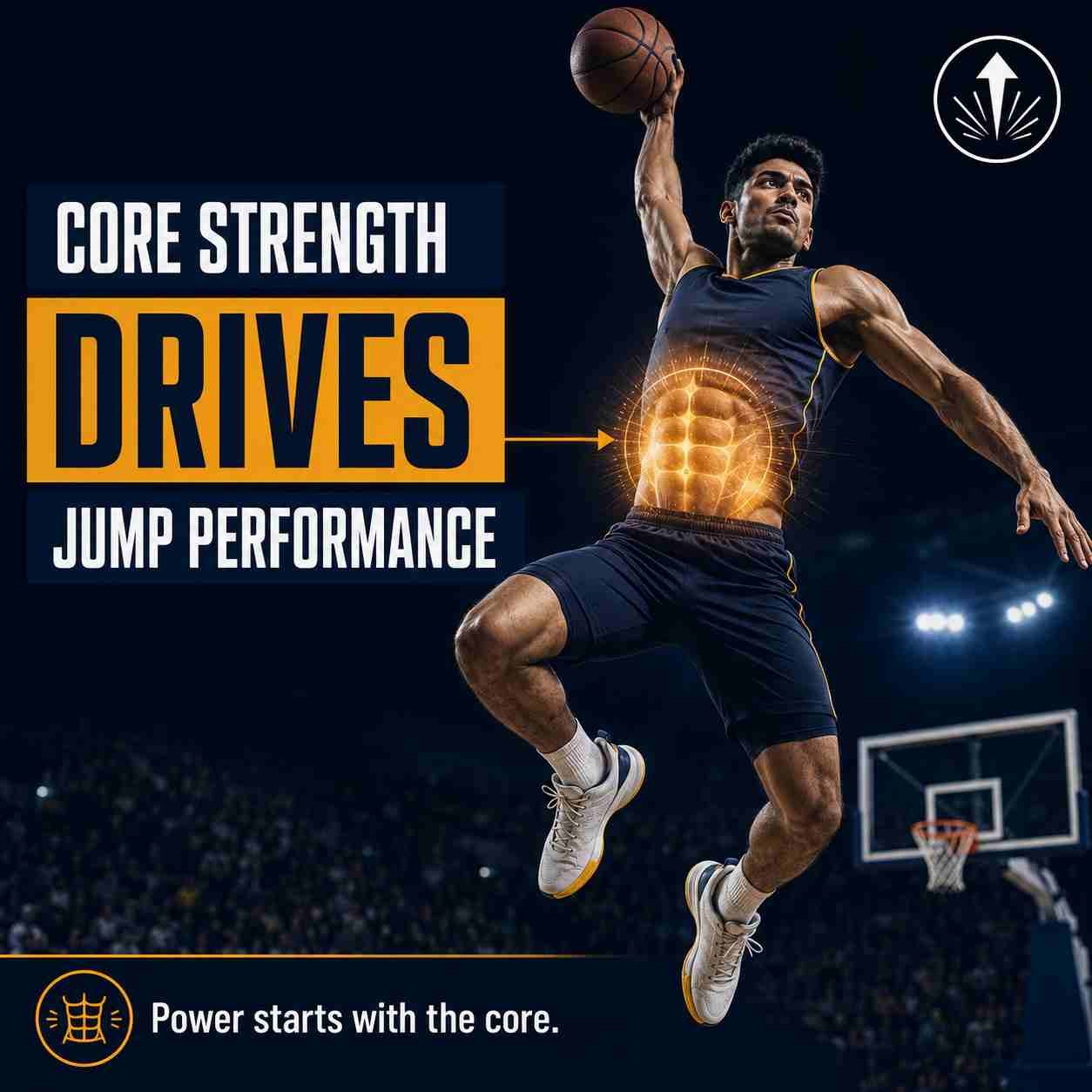
You've likely observed a disparity in performance in some athletes who are able to jump higher and move with more explosive force, if you're involved in sports, as an athlete, coach, or physiotherapist. That force was previously thought to come from the legs but it actually comes from the core.
A strong core is needed to improve vertical jump performance and boost overall athletic power.
Sports medicine specialists at Ortho-One Orthopaedic Speciality Centre, Coimbatore works with athletes who play basketball, volleyball, athletics and football to help them understand and address the physical foundations of peak performance.

A research study evaluated how endurance in core muscles influenced explosive jumping performance in 86 male college basketball players under the age of 21.
Researchers used:
The results showed athletes with a strong core:
There was a strong correlation between core strength and power which is essential for explosive athletic performance.
The Countermovement Jump (CMJ) test assesses lower-body explosive power and is assessed on a force platform. The test measures jump height, peak force, power output, flight time, velocity and acceleration.

Jump height - how high the athlete was able to jump
Peak force - the force produced during take-off
Power output - amount of force applied
Flight time - duration of staying up in the air
Velocity and acceleration - the speed of upward movement
These tests presented a comprehensive picture of the athletes physical readiness and injury risk profile.
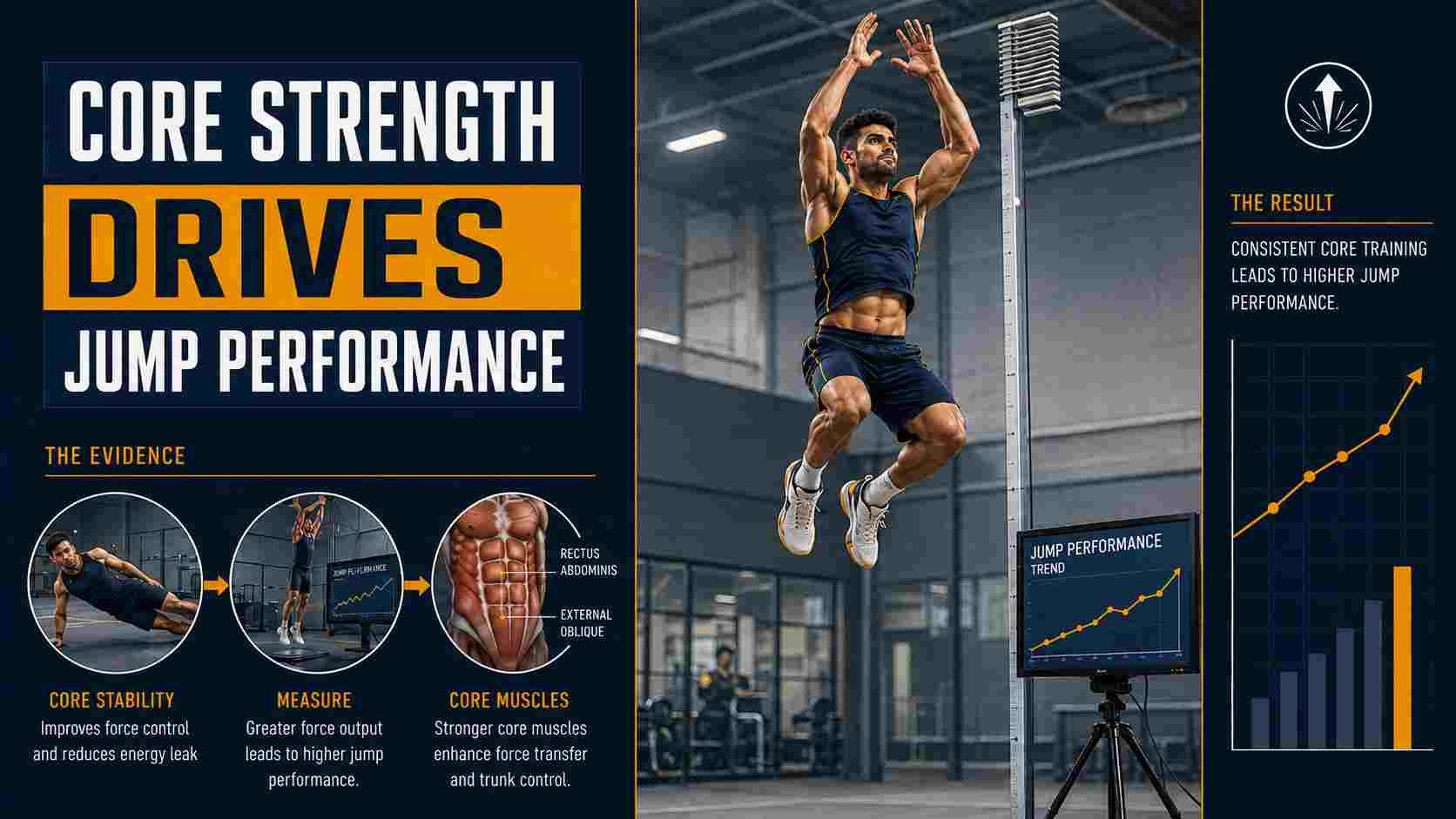
The core contains all the muscles of the trunk, the deep stabilisers of the spine, the muscles of the lower back, pelvis, and hips. Together, these muscles is a power link between the lower and upper body.

When the core is weak the force generated by the leg muscles cannot travel through the trunk. Instead of being transferred into upward momentum, the energy is lost through unwanted spinal movement and compensatory muscular activity.
On the other hand, a well-conditioned core acted as a rigid, stable platform through which force was transmitted through the body, with minimal energy loss.
This is why core strength had a strong positive correlation with relative power which was the most demanding physical output in explosive sports.
The biomechanical principles of core strength training can be used for basketball, volleyball, athletics, football, kabbadi and wrestling.
Basketball
Core strength helps with rebounds, layups and defensive positioning.
Volleyball
Core strength is useful for spiking, blocking and receiving serves.
Athletics
Core strength is good for high jump, long jump and sprinting.
Football (soccer)
Core strength can help athletes be better at aerial duels, shooting power and rapid directional change.
Kabbadi and wrestling
For explosive ground-based power.

Plank holds
For core endurance and spine stability.
Side planks
For lateral core stability and hip abductor exercises.
Dead bugs
For deep core muscles and neuromuscular coordination.
Pallof press
For protecting the spine from injury during explosive, multi-directional sports.
Bird dogs
To control and stabilise your lower back and hips.
Hanging leg raises
To strengthen abs and hip flexors.

It takes about 6 to 12 weeks of consistent core training to see improvements in core stability and functional power. However, results could vary based on the athlete's fitness, training, and technical execution.
The research findings carry significant practical implications for sports coaches, physiotherapists, and athletic trainers working with junior and senior athletes in Coimbatore and across Tamil Nadu.
At Ortho-One Orthopaedic Speciality Hospital, our sports medicine specialists and physiotherapy team offer comprehensive athlete assessments, movement screening, and evidence-based rehabilitation programmes tailored to the demands of your specific sport.
Core training is important to improve vertical jumps but it works best when combined with lower-body strength training, plyometrics and conditioning. A well-designed program targets all of these elements to increase vertical jump height.
Here are ways to find out if your core is weak:
At Ortho-One Orthopaedic Speciality Centre, Coimbatore, a physiotherapist can conduct an assessment to identify deficiencies and suggest core strengthening exercises.
Yes! Young athletes can try age-appropriate core stability exercises that are safe. A stronger core is linked to lower injury risk and better long-term outcomes for athletes. A physiotherapist at Ortho-One can design a program that is suitable for each age group.
A strong core helps maintain lower limb alignment during dynamic movements like landing and cutting. When the core is weak the knees compensate and increases the risk of ligament injuries such as ACL tears. Core training is therefore important to prevent knee injuries.
If you are a competitive athlete, a sports parent or a seasoned coach and looking to support your child's performance, the team at Ortho-One Orthopaedic Speciality Centre, Coimbatore can help with assessing core strength and helping them up their athletic potential and performance.

Address
Operational Hours:
10:00 AM – 7:00 PM | Monday to Saturday
Facilities
Treatments
Quick Links



 Book an appointment
 Athletes Empowerment
 Orthopaedic Education